


Interim manager in France: day rates, contracts and total cost.
An industrial interim manager is billed on a daily rate (average daily rate), not a salary. The range runs from €800 to €2,800 depending on the assignment’s criticality, the profile’s seniority, and the sector. Here is how that price is built, and why it often costs less than a vacant position or a failed hire.
For a foreign group hiring an interim manager in France: the day rate is invoiced by the firm (no French employment contract), the manager is on site within days, and the assignment ends when the job is done, with no severance.
For reference, the French federation France Transition puts the average day rate at about 1,330 euros excluding VAT (barometer, first half of 2025). Foreign groups also read our guides on the French works council (CSE) and on dismissal in France.
The daily rate of an interim manager in France
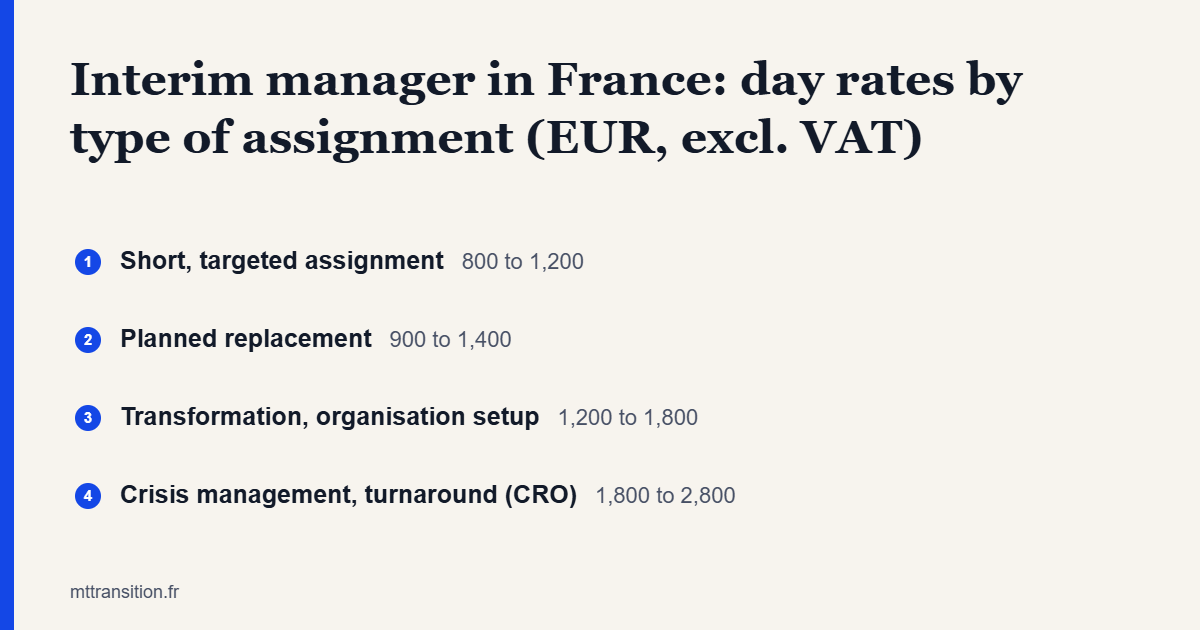
Unlike a permanent executive, an interim manager is not paid a monthly salary but billed at a daily rate, invoiced by the firm that mobilized them. On the French industrial interim management market, this daily rate generally sits between €800 and €2,800 (excl. VAT) per day, with an average of around €1,200 observed on assignments managed by MT-Transition. This wide range makes sense: a production director mobilized for a planned 3-month replacement is not billed the same way as a CRO sent urgently onto a workforce reduction plan.
Methodological note: these figures are a market estimate established by MT-Transition based on assignments handled and exchanges with the manager network. This is not a fixed rate: each quote is built around the actual scope of the assignment, framed from the first conversation, with no surprises afterward.
Ranges excl. VAT/day, indicative: each quote is scoped individually based on the profile and the actual context of the assignment.
What makes the price vary
Five criteria explain most of the gap between the low and high end of the range:
Assignment duration
A short assignment (under 2 months) often carries a higher daily rate: the manager must be immediately operational, with no gradual ramp-up. On a longer assignment (6-12 months), a degressive rate is more easily negotiated.
Urgency and mobilization timeline
A start within 48 hours in crisis management costs more than a planned mobilization with 3 weeks’ notice. Urgency shrinks the pool of immediately available profiles.
Seniority and profile scarcity
A generalist industrial director is easier to find than an experienced CRO in a turnaround plan or a CFO seasoned in LBO contexts. Scarcity of the profile comes at a price.
Industry sector
Regulated sectors (aerospace, pharma, defense) require profiles already familiar with quality frameworks and sometimes clearances: which narrows the pool and pushes the daily rate toward the higher end of the range.
Site size and complexity
Running a 400-person, multi-line site is not the same assignment as supporting a 30-person workshop. The managerial and budgetary scope factors into the calculation.
Total cost of a typical assignment
To make the calculation concrete, take an assignment of an interim production director over 3 months (average duration observed for this type of mandate), at a daily rate of €1,400 excl. VAT: at the higher end of the average range, consistent with a full-responsibility replacement assignment.
No hidden cost is added: no payroll charges to provision, no end-of-assignment severance, no employment tribunal risk. The interim manager is a service provider, not an employee: the daily rate covers the entire contractual relationship.
By comparison, a shorter crisis management assignment (a plant director mobilized for 6 weeks following a sudden departure, with immediate hands-on management of teams and quality indicators) is typically billed higher within the range (€1,800 to €2,200 excl. VAT/day), for a total cost that is often lower in absolute value: around €54,000 to €66,000 excl. VAT over 30 working days. The short duration offsets the higher daily rate.
How the rate is scoped with MT-Transition
The daily rate is never quoted blindly. It is built in three steps, generally completed in under 2 hours:
1. Scoping the need
Role concerned, site, urgency, expected duration, specific constraints (clearance, language, on-call duty). A 15-20 minute conversation is usually enough.
2. Identifying the available pool
Search within the MT-Transition network of interim managers based on the sector and seniority required, which refines the realistic daily rate for this specific profile rather than applying a generic range.
3. Written quote within 2 hours
Proposed daily rate, estimated duration, projected total cost, and terms: with no commitment on your part at this stage.
Interim manager or vacant position: what’s the real cost?
The natural instinct is to compare €84,000 to a production director’s fully loaded annual salary (often €90,000 to €120,000). But the real comparison isn’t there: it’s between the cost of an interim manager and the real cost of a vacant position or a failed hire. A leadership position left vacant for 4 to 6 months (the average time for a traditional hiring process) generates a loss of direction that is hard to quantify: delayed decisions, a team without direction, drifting production or quality. A hire that fails during the probation period costs the salary already paid, recruitment firm fees, and the process has to start over from scratch. We break down this comparative calculation in detail in our article Interim manager or recruitment: what’s the real cost?
The real return-on-investment calculation therefore has three components: the direct cost of the assignment (daily rate × duration), the avoided cost (the loss of direction or activity a vacant position would have caused) and the benefit delivered (indicators turned around, an interim secured, skills transferred to the existing team). Across these three components, most industrial leadership teams that use interim management consider the investment paid back as soon as the assignment avoids even a single month of unmanaged operational drift.
Who funds this type of assignment?
On industrial assignments managed by MT-Transition, the budget is carried by general management or the management of the site concerned, sometimes in coordination with HR when the assignment supports a reorganization. It is rarely treated as a simple recruitment line item: most leadership teams book it under a business-continuity or risk-management budget, in the same way as operational insurance. This is an important difference in framing: the daily rate doesn’t just buy a presence, it buys the guarantee that a critical position remains steered without interruption during the transition period, whether that means hiring the permanent incumbent, a reorganization, or exiting a crisis.
In multi-site groups, the cost can also be shared between headquarters and the site concerned when the assignment has a methodological scope intended to be replicated elsewhere (a new quality organization, a new production management system). This point is scoped from the first conversations to avoid any ambiguity on billing.
Frequently asked questions
Is the daily rate negotiable?
Yes, to some extent. The daily rate is scoped in the first conversation based on the exact scope of the assignment. A longer assignment generally allows for a degressive rate; a narrower scope can also lower the price.
Are there any hidden fees?
No. The daily rate covers the assignment in full. The only possible additional costs (travel, accommodation for a remote assignment) are always identified and validated before the start: never discovered after the fact.
What is the average billed duration?
On industrial assignments managed by MT-Transition, the average duration is between 3 and 6 months, ranging from a few weeks (crisis management) to over a year (long transformation mandates).
Does the cost vary by sector?
Yes. Regulated sectors (aerospace, pharmaceutical, defense) pull the daily rate toward the higher end of the range because they require profiles already trained on specific quality frameworks.
How do I get an accurate quote for my situation?
By describing your need in a few minutes: role, sector, urgency, estimated duration. We call back within 2 business hours with an accurate rate scoping, with no commitment.
Need an accurate quote?
Callback within 2 business hours · 3 targeted profiles within 72h · 100% industry
See also