


French works council (CSE): a guide for foreign parent companies.
Your group plans a reorganisation, a site closure or a new shift pattern in France. Before anything happens, the French works council, the CSE, must be informed and consulted. Many foreign parent companies discover this rule too late, when the project is already announced at group level. Here is what the CSE is, what it can do, and how to run a consultation without losing months.
The rules of the French works council are set by the French Labour Code (Code du travail), which applies to every employer in France, whatever the nationality of the parent company.
In short: in a French subsidiary with 11 employees or more, the CSE must be informed and consulted before any decision on organisation, headcount or working conditions. Its opinion is usually advisory, but skipping the procedure is a criminal offence and can freeze the project.
What is the French works council (CSE)?
The comité social et économique (CSE) is the elected body that represents employees in any French company with at least 11 staff. In companies with 50 employees or more, it has extended economic powers: it is consulted every year on the strategy, the financial situation and the social policy of the company, and before any significant change in organisation.
- Elected for four years by the employees, with a chair who is the head of the French entity or his delegate.
- A legal entity with its own budget in companies of 50 employees or more, funded by the employer.
- Access to a data base (the BDESE) that the employer must keep up to date: headcount, pay, investments, financial results.
When must the CSE be consulted?
- A restructuring, a reduction in headcount or a collective dismissal.
- The closure, transfer or relocation of a site or a production line.
- A change in working hours, shift patterns or organisation of work.
- The introduction of new technology or a new software that changes jobs.
- A merger, an acquisition or a change of control.
The rule is simple: the CSE must receive precise written information and have time to study it before the decision is taken. A press release or an internal announcement made at group level before the French consultation is a classic mistake.
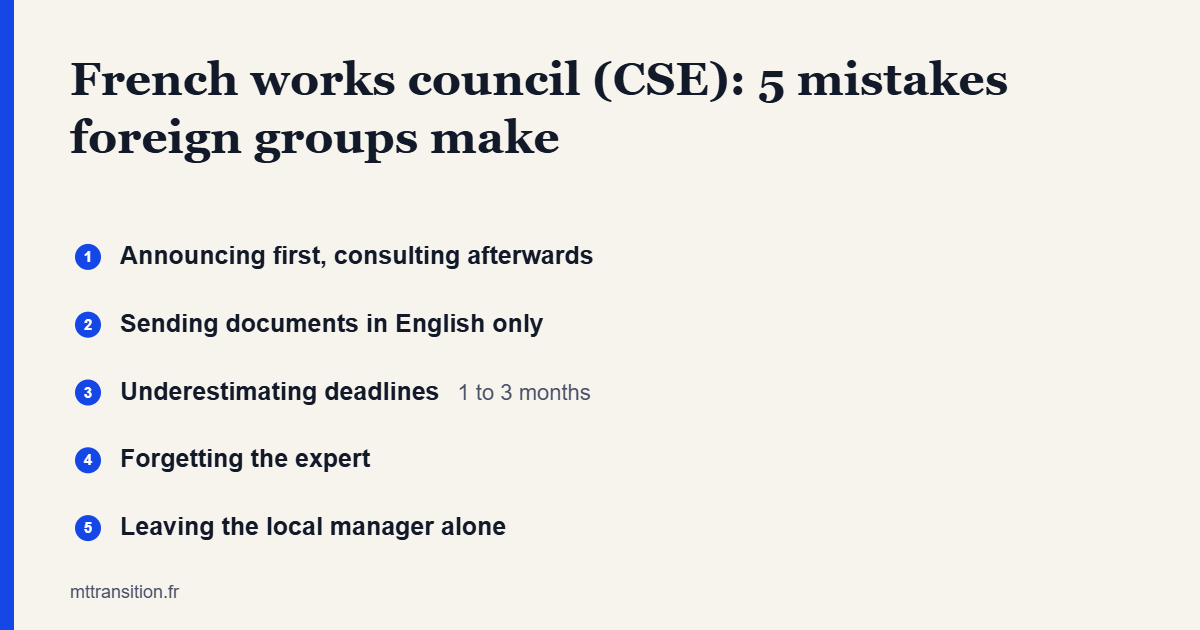
The 5 mistakes foreign groups make with the French works council
- Announcing first, consulting afterwards. A group announcement before the French consultation can be treated as an obstruction (délit d’entrave).
- Sending documents in English only. Documents given to French employees and their representatives must be in French.
- Underestimating deadlines. One month by default, two months with an expert, more with several sites.
- Forgetting the expert. The CSE can appoint an accountant or another expert, often paid by the employer.
- Leaving the local manager alone. A plant manager who has never run a consultation will struggle to hold the timetable and keep production running at the same time.
How an interim manager secures the consultation
An experienced French interim manager has already chaired CSE meetings in tense situations. He builds the consultation timetable with your lawyers, prepares the documents in French, leads the meetings, and keeps the plant running while the procedure goes on. Your group keeps control of the decision; the French entity keeps the legal and social pace.
MT-Transition presents three targeted profiles within 72 hours, all with industrial experience in France. See also French employment law for foreign investors and turning around a French subsidiary.
This page is general information, not legal advice. For your project, work with a French employment lawyer.
Frequently asked questions
Is a CSE mandatory in a French subsidiary?
Yes, as soon as the French entity has employed at least 11 people for 12 consecutive months. Elections are then organised by the employer, and the CSE is normally renewed every four years.
Can the CSE block a decision of the parent company?
In most cases its opinion is advisory: it cannot veto a restructuring. But the decision may not be implemented before the information and consultation procedure is complete. Skipping it is a criminal offence (délit d’entrave) and a judge can suspend the project.
How long does a CSE consultation take?
By default the CSE has one month to give its opinion, two months when it appoints an expert, and longer in multi-site groups with a central CSE. Those deadlines must be built into the project plan from day one.
Who pays the expert appointed by the CSE?
For most consultations linked to restructuring, the employer pays the expert in full. For some others the cost is shared. Budget it before the announcement.
What is the difference with a German Betriebsrat?
The Betriebsrat has real co-determination rights on several matters. The French CSE is mainly consultative, but its procedures, deadlines and the risk of criminal sanctions make it just as decisive for the timing of a project.
A specific need? Let’s talk about it today.
Callback within 2 business hours · 3 targeted profiles within 72h · 100% industry