


Dismissal in France: process, timeline and cost for a foreign group.
Letting someone go in France does not work like in the United Kingdom, Germany or the United States. The procedure is formal, the timing is set by law, and a mistake in form can cost more than the decision itself. Here is how dismissal works in France, what it costs, and the alternatives that foreign groups use.
Dismissal in France is governed by the French Labour Code (Code du travail) and by the collective agreement of your sector, whatever the nationality of the parent company.
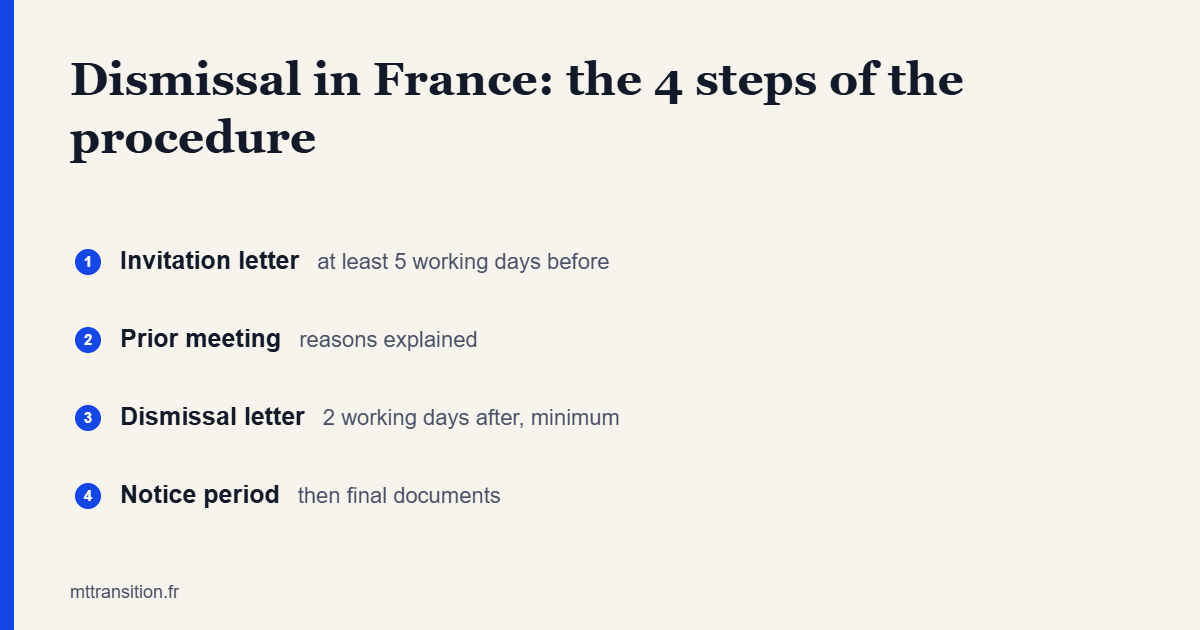
In short: a dismissal in France follows a strict sequence: invitation letter, prior meeting, written notification, notice period and severance pay. Counting the notice, it rarely takes less than one to three months. Mutual termination (rupture conventionnelle) and, above ten redundancies, a job protection plan (PSE) follow their own rules.
The three ways to end an employment contract
- Dismissal for personal reasons (motif personnel): performance, misconduct, unsuitability. It must rest on a real and serious cause.
- Dismissal for economic reasons (motif économique): economic difficulties, technological change, reorganisation to safeguard competitiveness, closure.
- Mutual termination (rupture conventionnelle): an agreement signed by both parties and approved by the labour administration.
Dismissal in France: the procedure step by step
- 1. Invitation letter to a prior meeting, sent by registered letter or hand-delivered, at least five working days before the meeting.
- 2. Prior meeting (entretien préalable): the employer explains the reasons and listens to the employee, who may be assisted.
- 3. Dismissal letter, sent at least two working days after the meeting (seven for an individual economic dismissal), stating the precise reasons.
- 4. Notice period, worked or paid, then final documents and severance pay.
Employees who sit on the works council (CSE) are protected: their dismissal also needs the authorisation of the labour inspector.
How much a dismissal in France costs
- Notice: one to three months of salary depending on seniority and status.
- Legal severance pay: one quarter of a month per year of service up to ten years, one third beyond, unless the collective agreement provides more.
- Paid leave not taken, paid at the end of the contract.
- Risk of litigation: if the cause is not real and serious, damages set by a legal scale based on seniority.
Collective redundancies and the PSE
Above ten redundancies over 30 days in a company with 50 employees or more, a job protection plan (plan de sauvegarde de l’emploi) is mandatory. It includes redeployment, training and support measures, is negotiated with unions or drawn up after consulting the French works council (CSE), and must be validated by the labour administration. Count several months.
Why foreign groups bring in an interim manager
A restructuring in France is first a matter of method: legal timetable, dialogue with the CSE, communication in French, and production that must keep running. A French interim manager who has already led this kind of project secures each step with your lawyers and protects your relationship with the teams that stay. MT-Transition presents three targeted profiles within 72 hours.
This page is general information, not legal advice. For your project, work with a French employment lawyer.
Frequently asked questions
How much notice must be given for a dismissal in France?
It depends on seniority and on the collective agreement: generally one month between six months and two years of service, two months beyond, often three months for managers (cadres). The collective agreement of your sector can set longer periods.
What is the legal severance pay in France?
After eight months of service, at least one quarter of a month’s salary per year of service for the first ten years, then one third of a month per year beyond. Many collective agreements are more generous, so check yours.
What happens if the dismissal is judged unfair?
The employment tribunal (conseil de prud’hommes) awards damages within a scale set by law, based on seniority, from a fraction of a month up to around twenty months of salary for the longest careers. Procedural errors alone can also lead to compensation.
What is a rupture conventionnelle?
A mutual termination agreed between employer and employee, with at least the legal severance pay. After signature there is a 15-day withdrawal period, then the labour administration must approve it. It is often faster and less risky than a contested dismissal.
When is a job protection plan (PSE) mandatory?
In companies with 50 employees or more, when at least ten people are made redundant over 30 days. The plan is negotiated or drawn up with the works council (CSE) and must be validated or approved by the labour administration (DREETS).
A specific need? Let’s talk about it today.
Callback within 2 business hours · 3 targeted profiles within 72h · 100% industry