


Doing business in France: what a foreign group must get right first.
France is the first destination in Europe for foreign investment, yet many foreign groups underestimate what comes after the company registration: hiring the first manager, the works council, payroll, and running a team that does not work the way head office does.
This guide covers setting up a subsidiary or a branch in France, choosing the legal form, tax basics, the first hires and the operating mistakes we see most often in foreign-owned industrial sites.
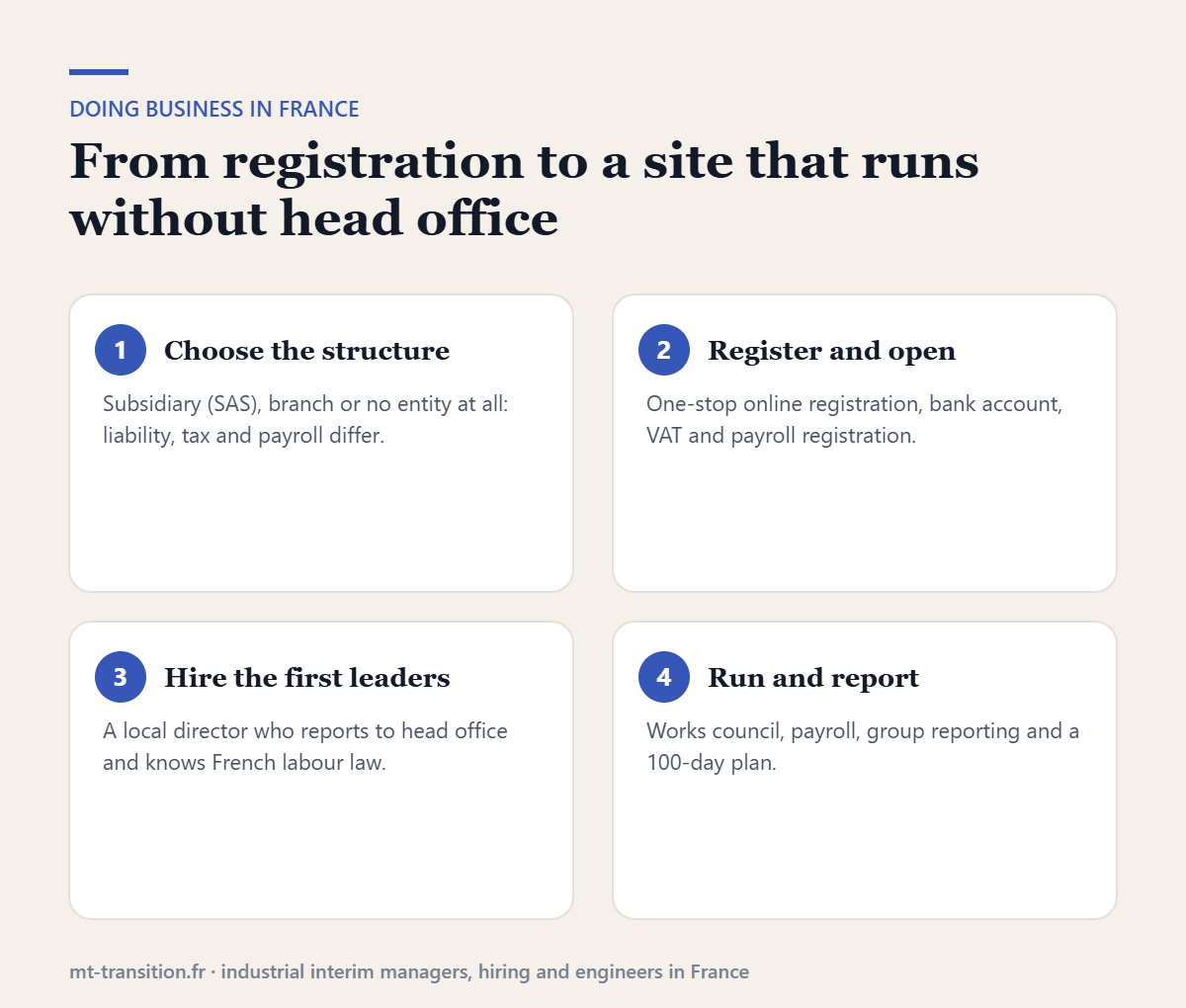
In short: A French SAS can be set up in a few weeks with no minimum capital. The hard part is not the paperwork, it is the first year of operations: the right local director, compliant contracts and early dialogue with employee representatives.
Why foreign groups choose France
France has been the leading European country for foreign investment projects for several years in a row. The EY attractiveness barometer published in May 2026 counted 852 foreign investment projects in 2025, including 354 factory creations or extensions. Business France reports that 1,021 foreign companies carried at least one investment project in France in 2025, 315 of them for the first time.
Foreign-controlled companies employ about 2.3 million people in France, roughly 762,000 of them in industry (Insee, 2022). American groups are the largest employers, followed by German and Swiss groups. The reasons are concrete: a large domestic market, a skilled engineering workforce, low-carbon nuclear electricity, public support for industry and direct access to the European single market.
Subsidiary, branch or no entity: the three ways to operate
| Option | What it is | When it fits |
|---|---|---|
| Subsidiary (SAS or SARL) | A French company owned by the foreign parent, with its own legal personality | A plant, a sales team of several people, any long-term activity |
| Branch (succursale) | A French establishment of the foreign company, registered in France, without separate legal personality | A first commercial presence, when the parent accepts direct liability |
| No entity | The foreign company employs staff in France directly through the national centre for foreign employers (CNFE) or uses an employer of record | One or two employees, a test of the market |
Most industrial groups choose the SAS (société par actions simplifiée). It has no minimum share capital, flexible bylaws, a president who can be a legal person (the parent company itself) and it can later be converted or merged without difficulty. A SARL is more rigid and mostly used by small family businesses.
Registering the company: what to expect
- One-stop online registration. Since 1 January 2023, all company formalities go through a single online portal run by the French intellectual property office (INPI), which forwards the file to the trade register, tax and social security bodies.
- Documents. Bylaws, proof of the registered office address, deposit certificate for the share capital, identity documents of the legal representative and, for a foreign parent, its own registration extract with a sworn translation.
- Timeline. Count two to six weeks between the decision and the registration certificate (Kbis), mostly driven by the bank account and the translation of foreign documents.
- After registration. VAT number, payroll registration with URSSAF, choice of the collective bargaining agreement that applies to your activity, mandatory health insurance for employees.
Tax basics in one paragraph
The standard corporate income tax rate is 25%. Small and medium companies pay a reduced 15% rate on the first €42,500 of profit under conditions. Research and development spending can benefit from the research tax credit (crédit d’impôt recherche), equal to 30% of eligible expenses up to €100 million. VAT is 20% at the standard rate. Transfer pricing between the French subsidiary and the group must be documented: it is one of the first points checked in a tax audit.
The first hires: where most foreign groups lose a year
The most expensive mistake is not legal, it is human. Many groups appoint a manager from head office who does not know French labour law, or hire a local director too quickly through a generalist agency. Three things make the difference:
- The French notice period. A manager or engineer in France usually has a three-month notice period. A permanent hire decided in January rarely starts before May. Plan an interim manager for the gap.
- The employment contract. A French permanent contract (CDI) includes a probation period, a collective agreement classification and, often, a non-compete clause that must be paid to be valid. See our guide to hiring in France.
- The employee representatives. From 11 employees, a works council (CSE) must be elected. From 50 employees, it must be consulted before many management decisions. See the works council guide.
Running the French entity from abroad
Once the company exists, head office faces a new question: who decides on site, and how fast? A French subsidiary run from Chicago, Munich or Singapore needs a director who can sign, negotiate with employee representatives, deal with the labour inspectorate and still report to the group in English, on group templates and on group timing. When that person leaves or does not deliver, the site drifts within months: delivery delays, quality incidents, social tension.
This is where MT-Transition intervenes: we place interim directors (site director, general manager of the subsidiary, CFO, supply chain, HR) within 72 hours for a shortlist, recruit permanent managers and engineers, and send experts on site for a ramp-up or an operational audit. See our support for foreign companies.
Five mistakes we see in foreign-owned French sites
- Copying the group employment contract instead of a French one aligned with the collective agreement.
- Announcing a reorganisation before informing and consulting the works council.
- Managing overtime as in the home country, without tracking working time in a way that stands up in court.
- Leaving the site without a legal representative on site for weeks after a departure.
- Reading French debate in meetings as resistance, when it is often how commitment is built. See French work culture.
A 100-day plan for a new French entity
| Period | Priorities |
|---|---|
| Days 1 to 30 | Bylaws and registration, bank, payroll provider, collective agreement, first job descriptions, interim director in place if needed |
| Days 31 to 60 | Hiring of key managers, employment contracts, health insurance and provident schemes, health and safety documents |
| Days 61 to 100 | Reporting to group, elections of the works council when the headcount requires it, first operational review of the site |
Frequently asked questions
How long does it take to set up a company in France?
The registration itself takes a few days once the file is complete. In practice, count two to six weeks, mostly because of the bank account and the translation of the parent company documents.
Is there a minimum capital for a French SAS?
No. A SAS can be created with a capital of one euro. Banks and suppliers, however, look at the capital and the parent company guarantee when they open credit lines.
Can a foreign company employ staff in France without a French entity?
Yes. It can register as a foreign employer with the national centre for foreign employers (CNFE) and pay French social contributions, or use an employer of record. Both are suited to one or two people, not to a plant.
Does the director of a French subsidiary have to live in France?
No legal rule requires it for a SAS president, but day-to-day management, signing, the works council and the labour inspectorate in practice require someone on site.
Can MT-Transition run our French site while we recruit?
Yes. We place an interim director with a shortlist within 72 hours, who reports to your head office in English and hands over to the permanent hire.
A specific need? Let’s talk about it today.
Callback within 2 business hours · 3 targeted profiles within 72h · 100% industry