


Sending managers to France: posting, A1 certificate, SIPSI and visas.
Many foreign groups start their French site with people from head office: a plant manager for the launch, engineers for the ramp-up, auditors for a few weeks. Each of these trips has formalities in France, and the penalties for missing them fall on the company.
This guide explains the difference between a business trip, a posting and a local contract, the SIPSI declaration, the A1 certificate, work permits and the talent passport for non-European staff, and when a local manager is the better option.
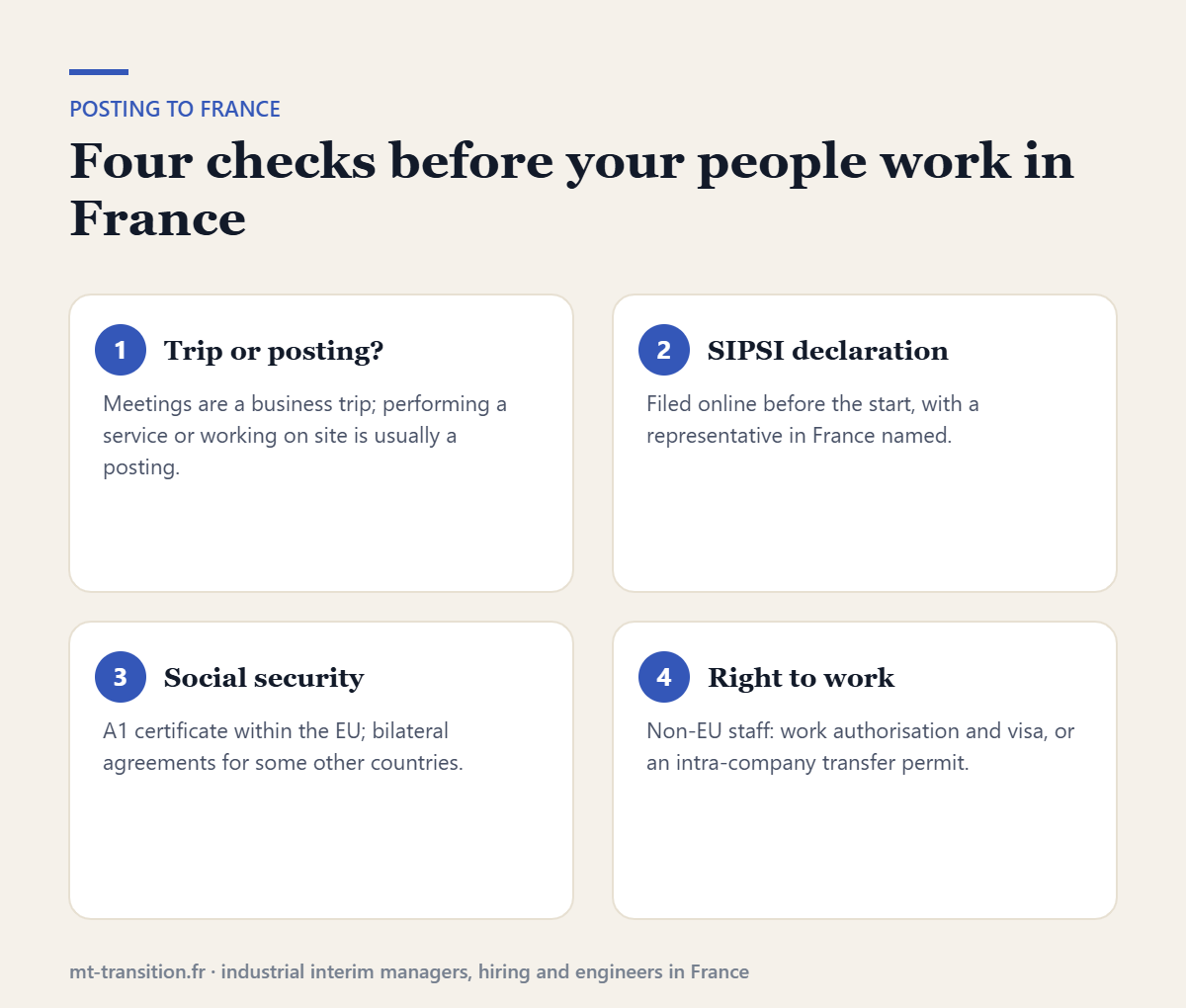
In short: Before posting an employee to France, the employer must file a SIPSI declaration and name a representative in France. European staff keep their home social security with an A1 certificate; non-European staff also need a work authorisation and a visa or residence permit.
Business trip, posting or local contract
| Situation | What applies |
|---|---|
| Business trip (meetings, negotiations, trade fairs) | No posting declaration in most cases; non-EU visitors may need a short-stay visa |
| Posting (work on a French site for a client or a group company, for a limited period) | SIPSI declaration, representative in France, French core labour rules (minimum wage, working time, health and safety) |
| Long stay or permanent role | French employment contract with the subsidiary, French payroll and social security |
The test is what the person does in France, not the length of the trip: installing a production line, supervising a ramp-up or working in a group subsidiary for the benefit of that subsidiary are generally postings, even for a few days.
The SIPSI declaration and the representative in France
- The employer files a prior declaration online on the SIPSI portal of the Ministry of Labour before the employee starts working in France.
- It names a representative in France who liaises with the labour inspectorate and keeps the required documents available, translated into French.
- When the employee works for a French client, the client must check that the declaration has been made.
- Missing declarations are punished by administrative fines of up to €4,000 per posted employee, doubled in case of repetition within two years, within an overall ceiling of €500,000.
What French rules apply to posted employees
During the posting, a core set of French rules applies: minimum wage and collective agreement minimum salaries, working time and rest, paid leave, health and safety, and equal treatment. Since the 2018 revision of the European posting rules, after 12 months (18 months with a justified extension) almost all French labour law applies to the posted employee, except the rules on contract termination and supplementary pensions.
Social security: the A1 certificate
Within the European Union, the European Economic Area and Switzerland, a posted employee can remain affiliated to the home social security system for up to 24 months, with an A1 certificate issued by the home country. Without it, French social contributions can be claimed. For other countries, bilateral social security agreements (for example with the United States, Canada, Japan or India) may allow a similar certificate of coverage.
Non-European employees: work authorisation and residence
- Intra-company transfer (ICT). For managers, experts and trainees transferred within a group: a specific residence permit, “salarié détaché ICT”, with simplified conditions.
- Talent passport (passeport talent). A multi-year residence permit of up to four years for qualified employees, employees on assignment within a group, innovative company staff and investors, under salary and qualification conditions.
- Applications. Work authorisations are requested online on the ANEF platform; the employee then applies for the visa at the French consulate. Count several weeks.
- Family. The talent passport allows the family to join the holder under a simplified procedure.
Posting a manager or hiring a local one?
Posting a plant manager from head office works for a launch, with a clear handover date. It is costly over time and often meets three limits: knowledge of French employee relations, language on the shop floor, and the legal role of the site director towards the works council and the inspectorate. Many groups combine a posted project director for the group interface with a French interim or permanent site director for daily operations.
How MT-Transition helps
We place French-speaking interim managers who work alongside your posted staff, or replace them when the posting ends, and we recruit the permanent local team. They report to your head office in English. See our support for foreign companies and hiring in France.
Frequently asked questions
Do I need a SIPSI declaration for a business trip to France?
Not for meetings, negotiations or trade fairs in most cases. It is required when the employee performs work in France for a client or a group company during a limited period.
How long can an employee stay on the home social security system?
Up to 24 months within the EU, the EEA and Switzerland with an A1 certificate. Bilateral agreements set the rules for other countries.
What happens after 12 months of posting?
Almost all French labour law applies to the posted employee, or after 18 months if the employer files a justified extension.
What is the French talent passport?
A residence permit valid up to four years for qualified profiles, including employees on assignment within a group, with a simplified procedure for their family.
Can an interim manager replace a posted manager?
Yes. A French interim manager can take over the site role at the end of a posting, often after a few weeks of overlap.
A specific need? Let’s talk about it today.
Callback within 2 business hours · 3 targeted profiles within 72h · 100% industry