


French work culture: how to manage a French team from a foreign head office.
Most articles on French work culture are written for expatriates looking for a job: lunch breaks, holidays, how to greet colleagues. This one is written for the executive who must make a French plant or subsidiary deliver, from Chicago, Munich, Stockholm or Singapore.
It covers how decisions are made in France, the place of debate and of hierarchy, the role of written rules and employee representatives, what French managers expect from head office and the misunderstandings that most often derail a French site.
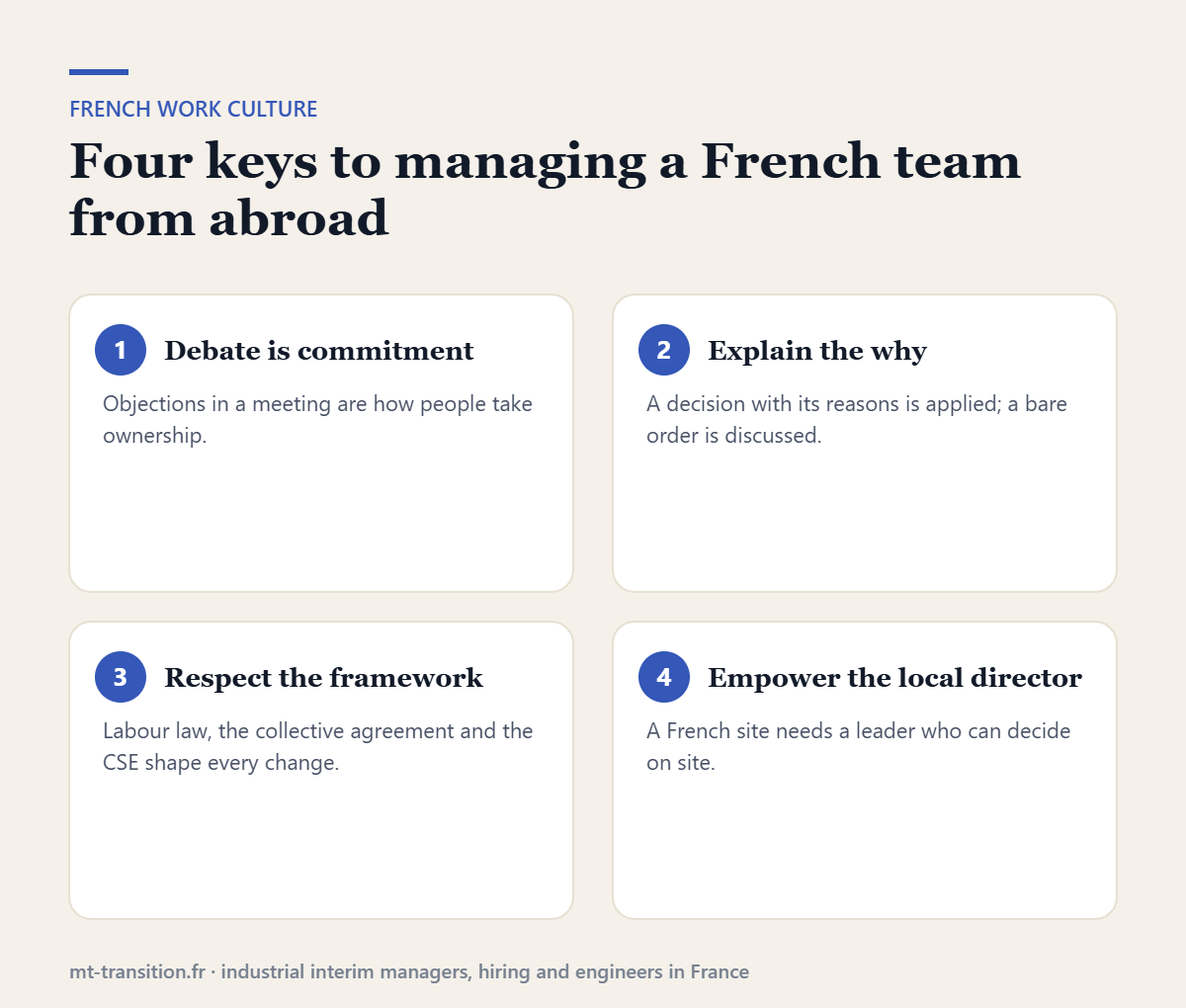
In short: French teams commit after debate, not before it. Expect challenges in meetings, a strong attachment to written rules and to job status, and a central role of employee representatives. Explain the why, involve the works council early and give the local director real authority.
Decisions: debate first, then execution
French education trains people to argue, to build a structured reasoning and to challenge it. In a meeting, a French engineer who objects to a plan is often not refusing it: he is testing it. Teams from cultures where disagreement is expressed privately, or where consensus is built before the meeting, can read this as resistance. The opposite risk is real too: a French team that stays silent may not have committed at all.
- Give the reasoning behind a group decision, with figures.
- Leave time for objections, then close clearly: who does what, by when.
- Write the decision down; written records carry weight in France.
Hierarchy, status and the “cadre”
French companies are often described as hierarchical, and job status matters: the distinction between managers (cadres) and non-managers shapes contracts, working time, pension schemes and even social life on site. At the same time, French employees value professional autonomy and expertise. A good French manager is expected to be technically credible, not only a coordinator.
Rules, written procedures and employee representatives
The French framework is legal and written: Labour Code, collective agreement, company agreements, internal regulations. Changes in organisation, working hours or tools often require informing or consulting the works council (CSE) before they are implemented. Head offices that announce a change globally and then “inform France” lose months. See the works council, unions and strikes and French labour law for employers.
Time: holidays, lunch and the calendar
- Employees have five weeks of paid leave, and many plants slow down or close for two to three weeks in August. Plan audits, launches and ramp-ups around it.
- Lunch is a real break; meetings at noon are poorly attended outside large groups.
- Bridges between public holidays in May reduce availability; plan capacity in advance.
- Response to evening emails varies; a “right to disconnect” must be organised in companies of 50 employees or more.
What French managers expect from head office
- Clarity on who decides. A site director who has to ask head office for every decision loses credibility with the team and with employee representatives.
- Respect for the local framework. Group policies must be adapted to French law, not imposed as they are.
- Reasoned targets. Targets with their logic and resources are accepted; arbitrary ones are debated, then worked around.
- Recognition of expertise. French engineers expect to be consulted on technical choices.
Misunderstandings that derail French sites
| Head office sees | What is often happening |
|---|---|
| “They always push back.” | They are testing the plan; involve them earlier. |
| “The site manager hides problems.” | He waits for a solution or fears the reaction; ask for facts every week. |
| “Nothing moves in August.” | It is planned leave; anticipate it in the schedule. |
| “The works council blocks us.” | It was consulted late, or the project was badly explained. |
| “Everyone is on strike in France.” | National strikes are visible; most private-sector sites have few strike days. |
When the gap becomes too wide
When a French site stops reporting reliable figures, loses its director or faces a social conflict, distance no longer works. A French interim director who speaks the language of head office (English, group reporting, group timing) and the language of the site (French employee relations, the shop floor, the CSE) restores the link in weeks. MT-Transition places these profiles with a shortlist within 72 hours. See our support for foreign companies and French interim manager vs remote management.
Frequently asked questions
Is French business culture hierarchical?
Partly. Status and hierarchy matter, especially the manager (cadre) status, but employees also expect autonomy and technical credibility from their managers.
Why do French teams challenge decisions in meetings?
Debate is how they build ownership. Explaining the reasoning and closing the discussion clearly turns objections into commitment.
Do French plants close in August?
Many slow down or close for two to three weeks, as employees take part of their five weeks of paid leave in summer.
How should head office work with the French works council?
Inform and consult it before implementing changes in organisation, working time or tools, with clear documents and time to discuss.
Can a foreign manager run a French site?
Yes, with a French deputy or an experienced interim director for employee relations, labour law and the shop floor.
A specific need? Let’s talk about it today.
Callback within 2 business hours · 3 targeted profiles within 72h · 100% industry