


French labour law for employers: the rules a foreign head office must know.
French labour law is detailed, written and enforced by inspectors and labour courts. For a foreign group, the risk is rarely a single big mistake: it is a series of small practices imported from head office that become a claim once an employee leaves.
This guide summarises what an employer in France must know: the sources of the rules, working time, overtime, paid leave, contracts, health and safety, employee representatives and the labour inspectorate.
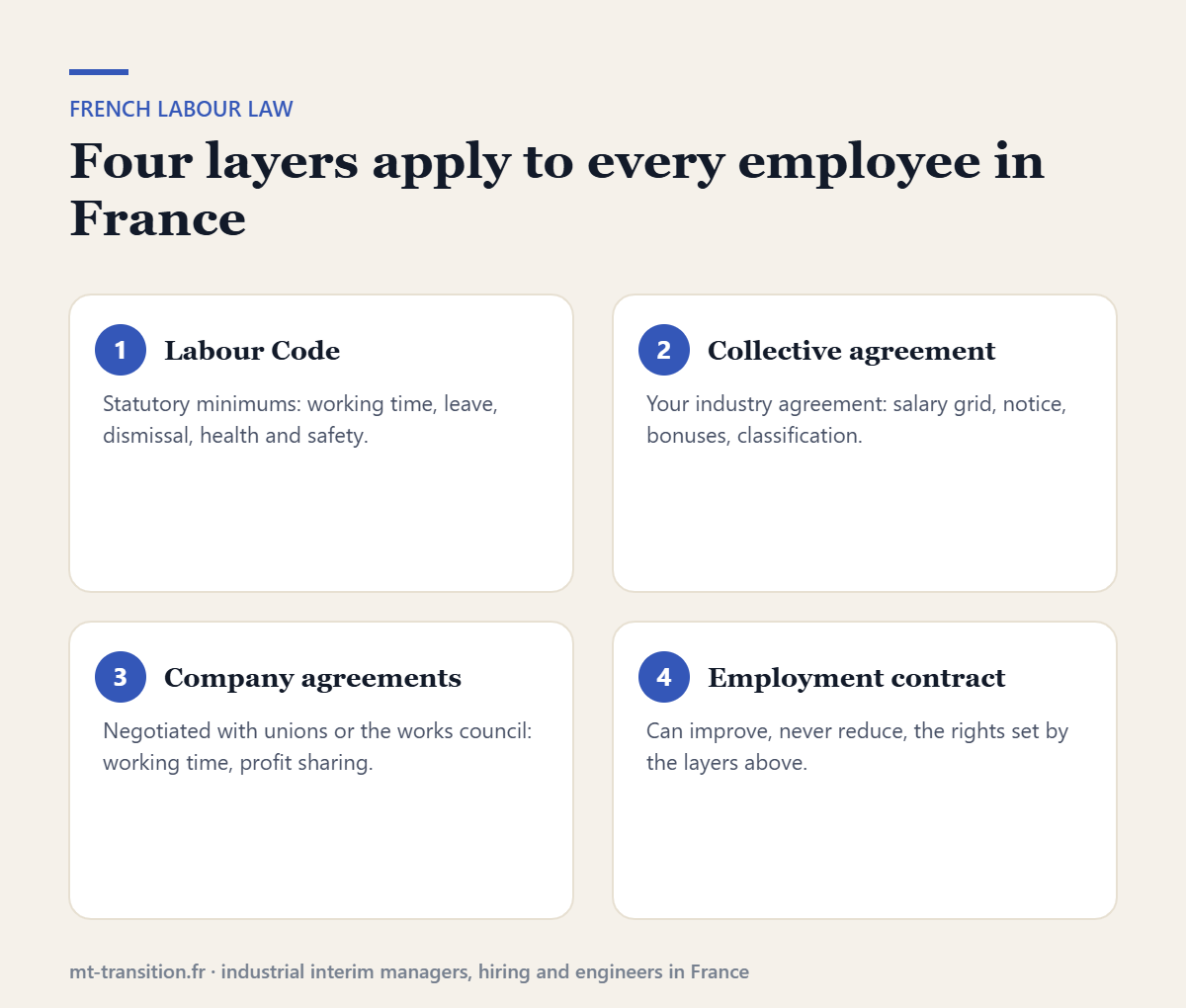
In short: Three layers apply at the same time: the Labour Code, the collective agreement of your industry and your company agreements. The collective agreement often sets higher minimum salaries, longer notice periods and extra rights. Read it before you hire.
How French labour law is organised
The Labour Code (Code du travail) sets the statutory rules. On top of it, almost every employee is covered by a sector collective agreement (convention collective), negotiated between unions and employer federations: in industry, the main ones are metallurgy, chemicals, plastics, food processing and construction. The metallurgy agreement was entirely rewritten and has applied since 1 January 2024, with a new classification of jobs. Company agreements can adapt many rules, especially on working time. The employment contract comes last and can only be more favourable to the employee.
Practical consequence: a foreign group cannot apply a single European policy. Salaries, notice periods, night shift premiums and sick pay top-ups depend on the collective agreement of each French entity.
Working time, overtime and rest
| Rule | Statutory reference |
|---|---|
| Legal working week | 35 hours (overtime beyond, unless a yearly days arrangement applies) |
| Overtime premium | 25% for the first 8 hours, 50% beyond, unless a company agreement sets another rate (minimum 10%) |
| Maximum per day | 10 hours (exceptions by agreement) |
| Maximum per week | 48 hours in a single week, 44 hours on average over 12 weeks |
| Daily rest | 11 consecutive hours |
| Yearly days for managers | Forfait jours: up to 218 working days a year, with a written agreement and a workload follow-up |
The yearly days arrangement (forfait jours) is the usual solution for autonomous managers. It requires a collective agreement that allows it, a signed clause in the contract and a real follow-up of workload. Without that follow-up, courts can cancel the arrangement and order the payment of overtime for up to three years.
Paid leave, public holidays and absences
- Paid leave. 2.5 working days per month worked, which makes 30 working days (five weeks) a year. Many companies close for two or three weeks in August.
- Public holidays. 11 public holidays; only 1 May is mandatory paid and not worked, except in continuous activities.
- Sick leave. Social security pays daily allowances; the employer tops up salary under the Labour Code and often more under the collective agreement.
- Parental leave. Maternity, paternity and parental leaves are protected, and dismissal during maternity leave is prohibited.
Contracts and ending them
The open-ended contract (CDI) is the norm; fixed-term contracts and temporary agency work are allowed only for listed reasons. Ending a CDI requires a real and serious reason and a formal procedure, or a negotiated mutual termination (rupture conventionnelle). Our detailed guides: hiring in France and ending an employment contract in France.
Employee representatives
From 11 employees, the company must organise the election of a works council (comité social et économique, CSE). From 50 employees, the CSE must be informed and consulted on the organisation, restructuring, working conditions and the economic situation, and it has its own budget. Trade unions can appoint union delegates who negotiate company agreements, including the mandatory annual negotiation on salaries. See the works council, unions and strikes.
Health and safety
The employer has a duty to protect the physical and mental health of employees. In practice this means a written risk assessment (document unique d’évaluation des risques professionnels) updated every year in companies of 11 employees or more, training, occupational health follow-up and a fast reaction to any alert. In an industrial site, a serious accident triggers an investigation by the labour inspectorate and can engage the criminal liability of the site director.
The labour inspectorate and labour courts
Labour inspectors can visit a site without notice, ask for documents and issue formal notices or reports. Individual disputes go to the labour court (conseil de prud’hommes). Claims for unpaid overtime, unfair dismissal and harassment are the most common. Since 2017, compensation for an unfair dismissal follows a scale that depends on seniority, between half a month and 20 months of salary.
Seven practices to check in a foreign-owned French site
- The collective agreement is identified, applied and the salary grid respected.
- Working time is recorded for every employee not on yearly days.
- Yearly days contracts are backed by an agreement and an annual workload interview.
- The risk assessment document is up to date.
- The works council has been elected and is consulted before decisions, not after.
- Employment contracts are in French and signed before the first day.
- Group policies (bonus, travel, IT) have been adapted to French law and, where needed, presented to the CSE.
When you need someone on site
A labour law issue in France is often an operations issue: a site director who left, a restructuring that must be prepared, a tense social climate. MT-Transition places interim site directors, general managers and HR directors who know French employee relations and report to head office in English. See our support for foreign companies.
Frequently asked questions
Is the 35-hour week a maximum in France?
No. It is the legal reference beyond which overtime is paid with a premium. The maximums are 10 hours a day and 48 hours in a week, 44 on average over 12 weeks.
Which collective agreement applies to my French company?
The one that matches your main activity, identified by your activity code and your actual business. In industry it is often metallurgy, chemicals, plastics or food processing.
Do managers in France get overtime?
Managers on a yearly days arrangement (forfait jours) do not count hours, but the arrangement must be backed by an agreement and a workload follow-up. Other managers are paid overtime.
How many days of paid leave does an employee have in France?
30 working days a year, five weeks, earned at 2.5 days per month worked, plus public holidays.
Is there an official English version of the French Labour Code?
The only legal text is in French, on Légifrance. Translations exist but have no legal value, which is why contracts and policies must be drafted in French.
A specific need? Let’s talk about it today.
Callback within 2 business hours · 3 targeted profiles within 72h · 100% industry