


Manufacturing in France: opening, buying or ramping up a plant.
Battery gigafactories in the north, electronics near Bordeaux, pharmaceuticals, aerospace and food: France is again a country where foreign groups build plants. Public support is real. The bottleneck is elsewhere: permits, the first managers, skilled engineers and a ramp-up that does not slip.
This guide covers why foreign manufacturers choose France, the main support schemes (France 2030, Choose France, research tax credit, regional aid), industrial sites and permits, staffing a new plant and the ramp-up phase.
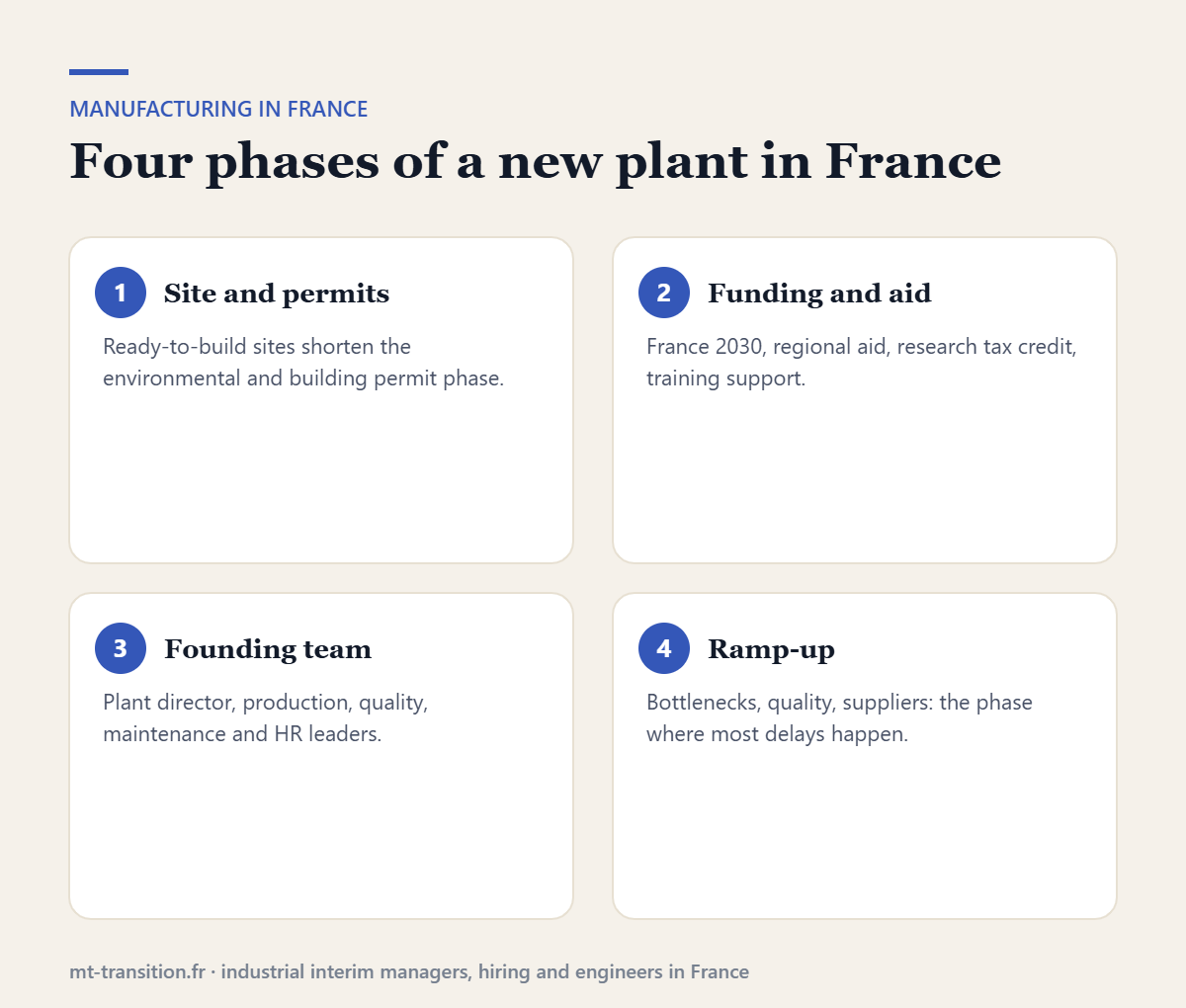
In short: France counted 354 foreign-invested factory creations or extensions in 2025 (EY). Funding and land are rarely the hardest part. The critical path is the team: a plant director, a production and a quality manager, and engineers hired early enough to be trained before start of production.
Why foreign manufacturers choose France
The EY attractiveness barometer published in May 2026 counted 852 foreign investment projects in France in 2025, including 354 factory creations or extensions, which keeps France in first place in Europe for industrial projects. Foreign-controlled companies already employ about 762,000 people in French industry (Insee, 2022). The usual reasons: a large market, engineering skills, low-carbon and comparatively stable electricity from nuclear power, port and logistics infrastructure, and a strong public commitment to reindustrialisation.
Recent examples show the range of sectors: ProLogium launched its battery plant project in Dunkirk, Foxconn announced a chip assembly plant near Bordeaux, and BYD is studying a car plant in France.
Public support schemes
| Scheme | What it offers |
|---|---|
| France 2030 | A €54 billion investment plan for industry and innovation: calls for projects, grants and loans in batteries, hydrogen, semiconductors, health, low-carbon industry |
| Choose France | The annual summit where foreign investors announce projects with the support of the State and Business France |
| Research tax credit (CIR) | 30% of eligible R&D expenses up to €100 million a year |
| Regional aid | Grants and loans from the regions, depending on location, jobs and investment, within EU state aid rules |
| Training and hiring support | Funding for training new hires and apprentices, through the regions and France Travail |
Business France and the regional development agencies are the first contacts: they help identify sites, aid and administrative contacts at no cost.
Sites and permits
- Ready-to-build sites. The State has labelled industrial sites (sites clés en main) where land, utilities and preliminary studies are prepared to cut lead times.
- Environmental permits. Many plants are classified installations (ICPE) and need an environmental authorisation or registration, with public consultation for larger projects.
- Shorter procedures. The 2023 green industry law aims to cut the average permitting time for a plant from 17 to 9 months.
- Energy connection. Grid connection for electricity-intensive plants is a project in itself; start it early.
Buying an existing plant instead
Acquiring a French plant gives you a team, permits and customers from day one, but also a works council, a collective agreement and the history of the site. Before signing, an operational due diligence checks the real capacity, the condition of equipment, the management team and the social climate. After closing, a 100-day plan with a strong site director is decisive. See operational due diligence of a French acquisition.
Staffing a new plant: the real critical path
Funding and permits are visible on a project plan. Staffing is often underestimated. A new plant needs its founding team six to twelve months before start of production: plant director, production, quality, maintenance, supply chain, HR and finance. Each of these managers usually has a three-month notice period with the current employer, and the engineers must then be trained on your process.
- Appoint the plant director first; he or she builds the rest of the team.
- Hire quality and maintenance leaders early: they qualify equipment and processes.
- Plan the HR framework: collective agreement, shift patterns, works council once the headcount requires it.
- Use interim managers to start before the permanent team is complete.
The ramp-up: where most delays happen
A ramp-up fails for predictable reasons: a bottleneck machine, scrap rates that do not fall, suppliers that do not follow, operators trained too late, and a management team that changes during the launch. Experienced ramp-up managers and engineers sent on site for a few months reduce the risk more than any additional investment. See production ramp-up bottlenecks.
How MT-Transition supports new and acquired plants
We provide the people side of an industrial project in France: interim plant directors and production directors, the permanent recruitment of the founding team, and engineers and experts in technical assistance for the ramp-up, invoiced per day. Our managers report to head office in English. See our support for foreign companies.
Frequently asked questions
How long does it take to open a plant in France?
Count one to three years from site selection to start of production, depending on permits, construction and recruitment. Ready-to-build sites shorten the first phase.
What public support is available for a new plant in France?
France 2030 calls for projects, regional grants and loans, the research tax credit and training support, within EU state aid rules. Business France helps identify them.
Who should be hired first for a new French plant?
The plant director, then quality, maintenance and production leaders, six to twelve months before start of production.
Is it better to build or to buy a plant in France?
Buying is faster but comes with an existing team, works council and history. An operational due diligence tells you what you really buy.
Can MT-Transition staff a ramp-up?
Yes: interim managers for the leadership roles and engineers and experts on site, invoiced per day, plus permanent recruitment of the team.
A specific need? Let’s talk about it today.
Callback within 2 business hours · 3 targeted profiles within 72h · 100% industry