


Labour costs in France: salaries, employer contributions and payroll.
Labour cost is the first concern of foreign groups in France: in the AmCham and Bain barometer of American investors, 77% of respondents named it. The figure that matters is not the gross salary but the full cost to the employer, and how payroll works month after month.
This guide explains the French minimum wage in 2026, how gross and net salaries work, the employer contributions on top, mandatory benefits, payroll obligations and how to budget a manager or an engineer.
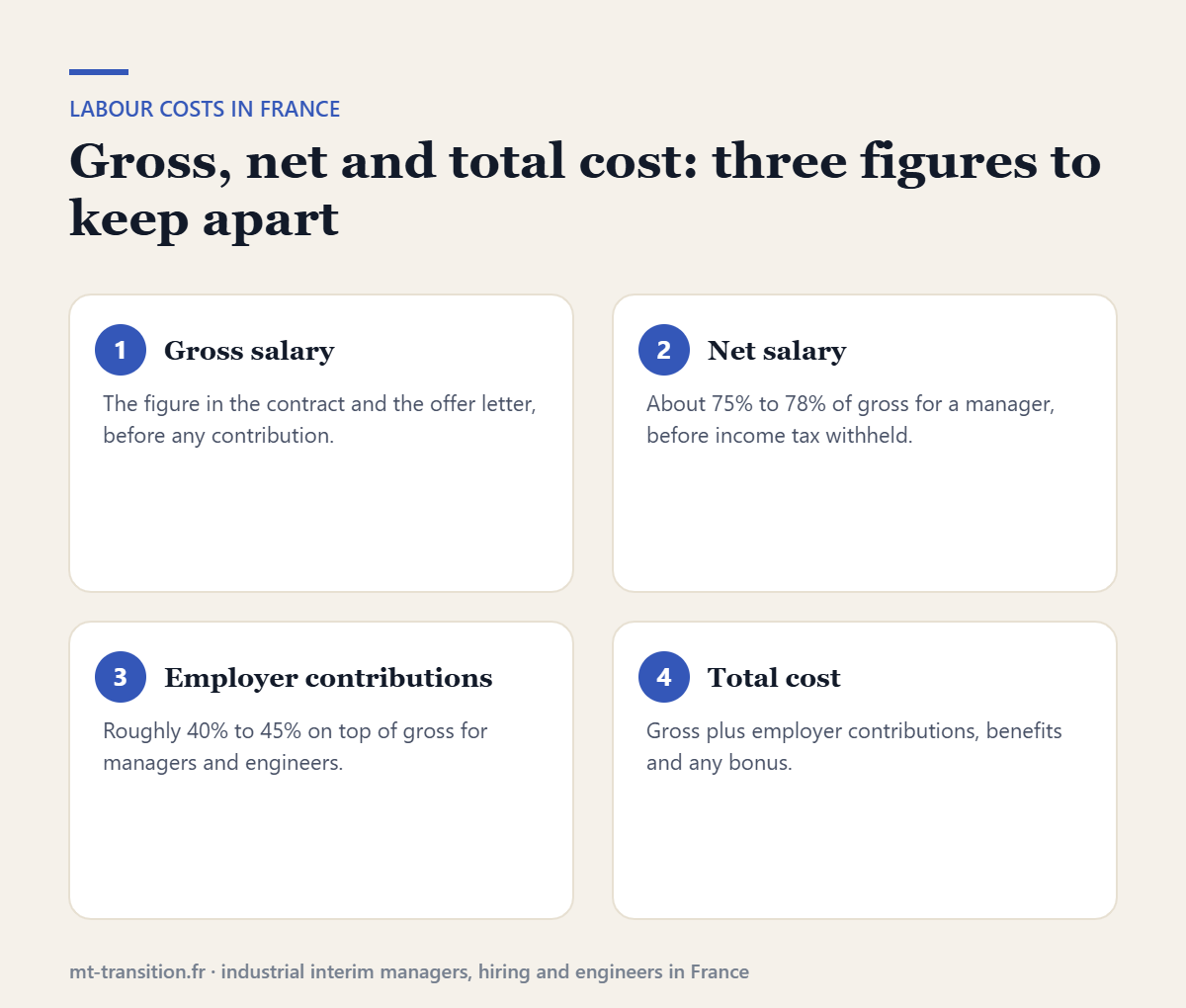
In short: Since 1 June 2026, the minimum wage is €12.31 gross per hour, €1,867.02 gross per month for 35 hours. For managers and engineers, employer contributions typically add about 40% to 45% to the gross salary; near the minimum wage they are much lower thanks to contribution reductions.
The minimum wage (SMIC) in 2026
The minimum wage applies to all employees. It was raised to €12.02 gross per hour on 1 January 2026 and again to €12.31 gross per hour on 1 June 2026, that is €1,867.02 gross per month for a full-time job of 35 hours. Collective agreements set their own minimum salaries by job level, often above the SMIC for skilled positions: in industry, the salary grid of your agreement is the real floor.
Gross, net and employer cost
In France, salaries are always discussed in gross annual terms. Employee contributions (pensions, health, unemployment, CSG and CRDS) are deducted from gross to give the net salary, then income tax is withheld at source. Employer contributions are paid on top of gross.
| Example (manager, 2026) | Order of magnitude per year |
|---|---|
| Gross salary | €60,000 |
| Employee contributions | about €13,000 to €15,000 |
| Net salary before income tax | about €45,000 to €47,000 |
| Employer contributions | about €24,000 to €27,000 |
| Total employer cost | about €84,000 to €87,000 |
These figures are orders of magnitude for budgeting, not a payslip. The exact rate depends on the collective agreement, the pension and provident schemes, the company size and the transport and housing levies of the region. Always ask your payroll provider for a simulation before making an offer.
What employer contributions finance
- Health, maternity, disability and death insurance (social security).
- Old-age pensions: basic scheme and mandatory complementary scheme (Agirc-Arrco).
- Unemployment insurance and the wage guarantee fund.
- Family allowances, workplace accident insurance (rate depends on the risk of your activity), training and apprenticeship levies.
- Mandatory company health insurance (mutuelle), of which the employer pays at least 50%, and a provident scheme for managers.
Contributions are strongly reduced on low salaries, up to about 1.6 to 3 times the minimum wage depending on the scheme. This is why the cost structure of a French plant with many operators is very different from that of an engineering centre.
Other items in the cost of an employee
- Thirteenth month. Not a legal obligation, but frequent in collective agreements and company practice.
- Profit sharing. Mandatory profit-sharing (participation) once the company has had 50 employees for five consecutive years; optional incentive schemes (intéressement) are common.
- Transport. The employer pays half of public transport passes.
- Meal vouchers. Optional, partly exempt from contributions.
- Overtime and shift premiums. Set by law and the collective agreement. See French labour law for employers.
Payroll obligations
Salaries are paid monthly. Each month, the employer files a nominative social declaration (DSN) that feeds all social bodies, withholds income tax at source and gives each employee a payslip. Most foreign groups outsource payroll to an accounting firm or a payroll provider in France: payroll is technical, changes every year and errors become claims.
How to budget a French team
- Identify the collective agreement and the job levels before writing the job descriptions.
- Benchmark salaries by region: Paris and Lyon are higher than most industrial regions.
- Ask for a total cost simulation, including health insurance, provident scheme and bonuses.
- Add the cost of the hiring gap: notice periods of up to three months, during which the role is often covered by an interim manager.
- Compare with alternatives: an interim manager is invoiced per day with no employer contributions on your side; experts and engineers in technical assistance are invoiced per day too.
How MT-Transition fits in the budget
Our interim managers, engineers and experts are invoiced per day worked, on a time and materials basis (we never sell fixed-price work packages). You do not carry employer contributions, notice periods or severance. Daily rates and examples: interim manager daily rates and interim manager vs recruitment cost.
Frequently asked questions
What is the minimum wage in France in 2026?
€12.31 gross per hour since 1 June 2026, or €1,867.02 gross per month for 35 hours a week. It was €12.02 from 1 January to 31 May 2026.
How much does an employee cost on top of the gross salary in France?
For managers and engineers, employer contributions typically add about 40% to 45% to the gross salary. Near the minimum wage, reductions bring the rate much lower.
Are salaries in France quoted gross or net?
Gross annual salary is the standard in offers and contracts. Net is roughly 75% to 78% of gross for a manager, before income tax withheld at source.
Is a thirteenth month mandatory in France?
Not by law. It is due when the collective agreement, the contract or a company practice provides for it.
Can we outsource payroll in France?
Yes, and most foreign subsidiaries do. The monthly DSN declaration, withholding tax and collective agreement rules make payroll a specialist task.
A specific need? Let’s talk about it today.
Callback within 2 business hours · 3 targeted profiles within 72h · 100% industry